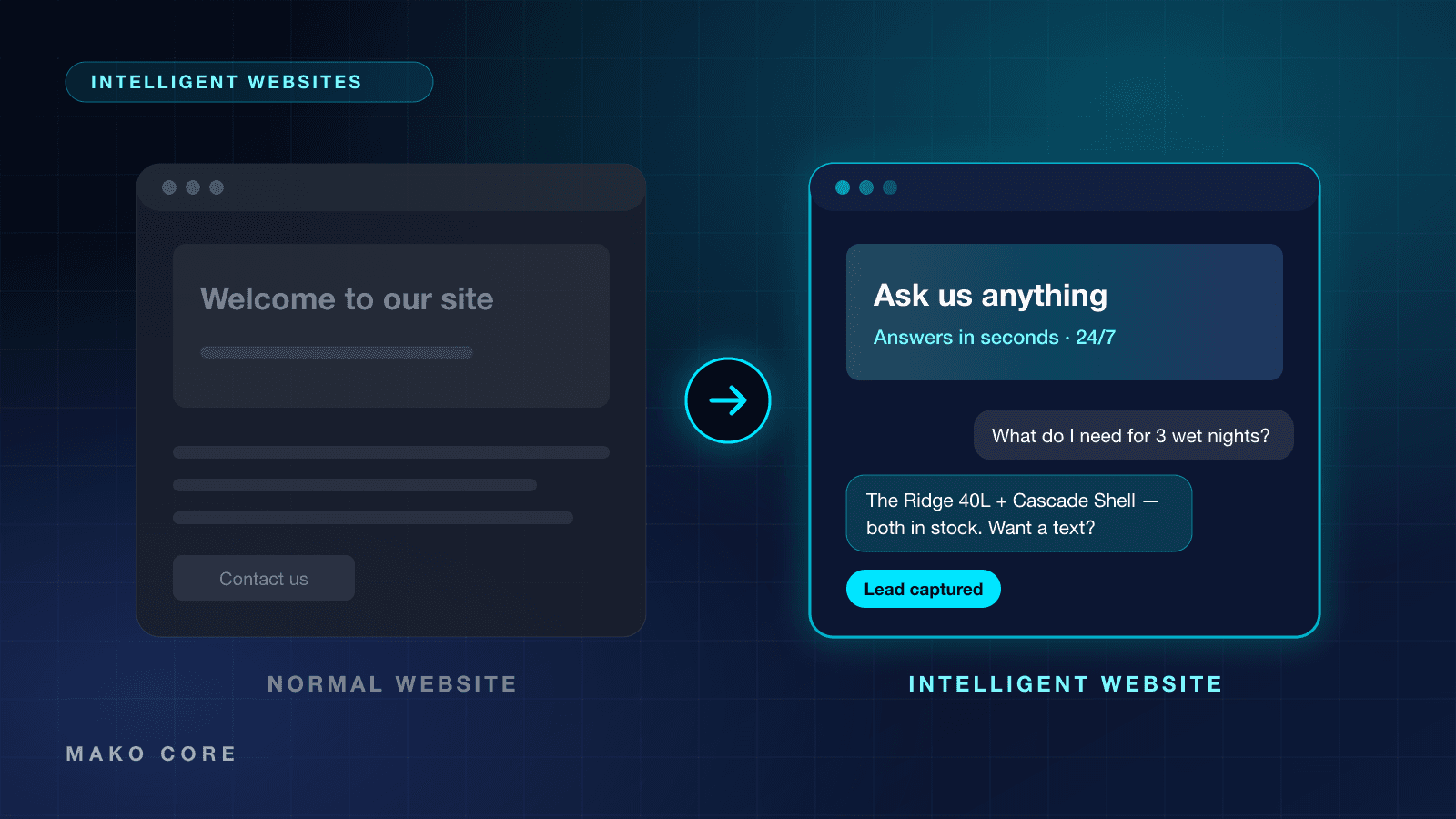
An intelligent website is a business website that does work, not just displays information. It answers customer questions in the business's own voice, captures and qualifies leads, learns from every visit, and connects to the tools the business already uses — with a person approving anything that goes out. A normal website publishes pages and waits for someone to fill out a contact form. The difference isn't the design. It's whether the website is part of how the business runs.
What is an intelligent website?
Think of it as your existing website with a working brain behind it. It keeps your brand, your pages, and your products — and adds five capabilities most business sites don't have:
- It answers questions in seconds, day or night, using your real products, prices, and policies — and hands off to a person when it should.
- It turns conversations into leads, ranks them by intent, and drafts the follow-up for you to approve.
- It learns what visitors ask for, what they can't find, and which pages actually sell.
- It connects to your email, calendar, CRM, and payments, so information stops living in separate tools.
- It prepares the next move — a website update, a campaign, a follow-up — and waits for your yes.
- It's agent-ready: the AI agents customers send to shop and book can read it and use the actions you allow.
Normal website vs. intelligent website
| Normal website | Intelligent website | |
|---|---|---|
| Customer questions | A contact form; a reply in a day or two | Answers in seconds, 24/7, in your voice — with a hand-off to a person |
| Leads | Form submissions sitting in an inbox | Captured, scored by intent, with a follow-up drafted for approval |
| What you learn | Page views and bounce rates | What visitors ask for, want, and can't find |
| Updates | Wait for a developer or fight a page builder | Point at the page and change it — or just ask — then publish |
| Your tools | Website, CRM, email, and calendar work separately | Connected in one workspace |
| Marketing | Separate campaigns built from scratch | One idea drafted for the website, social, blog, and ads together |
| AI search | Hope ChatGPT or Google finds you | Content structured so AI assistants can understand and cite you |
| AI agents | Agents can't reliably read it or act on it | Agent-ready: structured data and safe actions agents can use, on your rules |
Why the website is becoming the core of the business
For most small and midsize businesses, the website is where customers show up first. Every question a visitor asks is a signal about what the market wants — and until now, most of those signals were lost in a chat widget or never asked at all.
At the same time, buyers increasingly ask AI assistants like ChatGPT, Perplexity, and Gemini for recommendations, and those assistants read websites to answer them. The site that listens, learns, and explains the business clearly becomes the natural hub for sales, marketing, and service. That's what we mean by the website as the core of the business: not a brochure, but the place where customer demand is captured, understood, and turned into the next move.
What changes for an owner-led business
- A morning brief: what your website did overnight, and the few things that need you.
- Leads ranked by who's ready to buy, each with a follow-up drafted.
- One opportunity — say, a product that's suddenly in demand — turned into a website update, social posts, a blog article, and a small ad campaign.
- Approvals from your phone between meetings, instead of a backlog on your desk.
What an intelligent website should never do
- Send, post, publish, or spend without a person approving it.
- Invent prices, results, or promises the business hasn't made.
- Lock you into one vendor or one AI model as better options appear.
- Force a rebuild — the right approach keeps your brand and the site you already have.
How to get started
Start with the website you have. Transform it first, so customers get answers and you get leads and insight right away. Then add one workflow at a time — follow-ups, campaigns, reporting — starting with your biggest bottleneck, and measure what each one changes before adding the next. That's the approach Mako Core takes with every business, and you can watch a store go from a plain site to an intelligent one in the live demo at makocore.com/demo.
Frequently asked questions
- What's the difference between an intelligent website and a website with a chatbot?
- A chatbot answers questions from a generic script. An intelligent website answers from the business's own products, policies, and rules, captures and ranks the leads those conversations create, drafts the follow-up, and connects to the rest of the business — so the conversation leads somewhere.
- Do I need to rebuild my website to make it intelligent?
- No. The goal is to keep your brand and the site customers already know, and add the intelligence behind it — answers, lead capture, learning, and connected tools.
- Is it safe to let AI talk to my customers?
- It should be, with the right rules: answers come only from information you've approved, the site hands off to a person when a question needs one, and nothing is sent, published, or spent on your behalf without your approval.
- How does an intelligent website help with AI search?
- AI assistants like ChatGPT, Perplexity, and Gemini answer buyers by reading websites. An intelligent website keeps your content clear, current, and structured around the questions customers actually ask, which makes it easier for those assistants to understand and cite your business.
- Who is an Intelligent Website for?
- Owner-led businesses, startups, and fast-growing companies that need extra capacity — big-company speed and service without a big-company technology team. We transform the site you have or build a new Intelligent Website.